
Automatic Gain Control Microphone PreAmp
This microphone preamplifier incorporates automatic gain control, which keeps the output level fairly constant over a wide range of input levels. The circuit is especially suitable for driving the modulator of a radio transmitter and allows a high average modulation index to be achieved.
It may also be used in P.A. systems and intercoms to provide greater intelligibility and compensate for variations between speakers (the users of those devices).
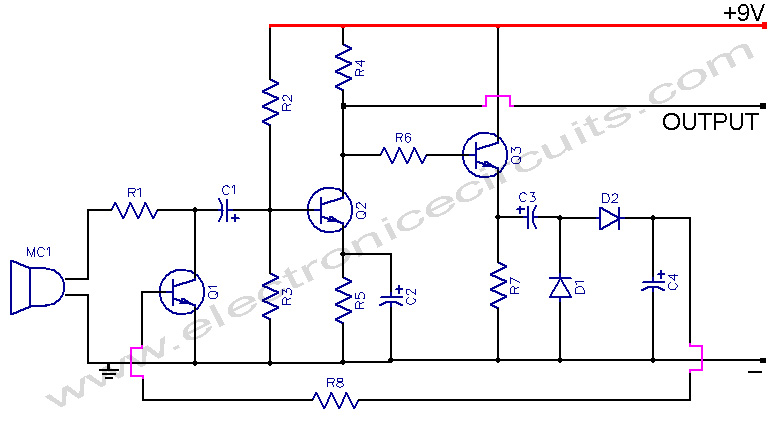
| PARTS LIST | |
| R1 | 15kΩ |
| R2 | 100kΩ |
| R3 | 27kΩ |
| R4 | 2.2kΩ |
| R5 | 1kΩ |
| R6 | 10kΩ |
| R7 | 680Ω |
| R8 | 2.2kΩ |
| C1 | 10µF 16V |
| C2 | 47µF 16V |
| C3 | 47µF 16V |
| C4 | 47µF 16V |
| D1 | 1n4148 |
| D2 | 1n4148 |
| Q1 | BC108 |
| Q2 | BC108 |
| Q3 | BC108 |
| MC1 | <5KΩ Microphone |
The actual signal amplifier stage is Q2, which operates in common emitter mode, the output signal being taken from its collector. A portions of the output signal is fed through emitter follower Q3 to a peak rectifier comprising D1/D2 and C4. The voltage on C4 is used to control the base current of Q1, which forms part of the input attenuator. At low signal levels the voltage on C4 is small and Q1 draws little current. As the input signal level increases the voltage on C4 rises and Q1 turns on mode, thus attenuating the input signal. The net result is that as the input signal increases it is subject to a greater and greater degree of attenuation and the output signal therefore remains fairly constant for a wide range of input levels. The circuit is suitable for signals with a peak input level up to 1 volt. The microphone may be replaced by a small loud-speaker for intercom use.
Please send your ideas, those are very important for our success…
I want to quote your post in my blog. It can?
And you et an account on Twitter?
I have tried to recreate this and i cannot get it to work, i have checked my circuit several times, followed the schemtic exactly, used the exact components and ive also tried using a lodspeaker on the input instead of a condenser mic.
im getting 1.37V on the output of the Preamp (DC) but ive wired this into my main amplifier what has a sensitivity down to 20mV and it does not work
Please try using coupling capacitor to connect between this preamp and your main amplifier.
example: connect the 4.7µF capacitor a + terminal should be connected to preamp output.
Hi You cannot use condencer mic you have to use moving coil mic only. reduce R1 to 4.7K increase R4 to 3.3K. Reverse C3 polarity, increase R6 to 47K use an out put coupling capacitor as indicated by Ravindra. Initially remove R8 and try for the sound out put, if every thing is ok now connect R8 to compress the sound.
Please I need more circiuts on michrophone
Hi everyone!
Has anybody already tried this circuit and does it work at all? I would like to build one! Is it necessary to modify any components of it?
Please reply! Thanks!
Yes I’ve built this circuit and initially thought it didn’t work. I wanted to use it to have AGC on an audio mixer microphone input channel. Using test equipment I discovered that with and input of -40dBm (typical level from a dynamic microphone) it has a gain of about 22dB @ 1kHz. The output level will therefore be about -20db which is too low to drive a typical line input stage. However as the input level is raised the circuit does exhibit and exponential gain. An input of 0dBm @ 1 kHz gives and output of -2dB. The way I have used this circuit is as an agc stage being fed from the output of another mic preamp and feeding into the mixer, but on a ‘line’ input. Other thing to note is that the circuit as shown will present a dc voltage on the output. To decouple this I use a 4.7uF electrolytic in series with the output.
This circuit is an unbalanced amplifier and I have to modify it for balanced operation with 600ohm 1:1 audio transformers in the input and output. If you get the levels right this ciruit works really well and copes with varying levels of sound at the microphone. Our application uses it to keep a radio announcer voice level fairly constant. Using it as an agc for higher audio levels also makes it less prone to pick up induced noise.
I have used this circuit in one of my projects and it did work greatly.Instead of using microphone, I have connected signal generator directly.For 20 Vpp input, it gives 2.2 Vpp output voltage, and for 200 mVpp input voltage, it gives 1.6 Vpp at the output.
Hi, Would this be suitable for a magnetic pickup? The voltage range seems to be from about 20mV to 700mV and I could do with it feeding a digital circuit, possibly via another amplifier if necessary. (basically it’s a tacho for a machine picking up the signal from one of the gears – hence the magnetic pickup, to feed a MCU to calculate and display the RPM).
Many Thanks